

Jolabokaflod

Christmas Book Flood • Reading for Pleasure


Leave a comment

Christmas traditions (Advent calendar, Day 5)

What is the origin story of Christmas cards?

First Christmas card h/t V&A

The tradition of sending Christmas cards dates back to the 19th century in England, with its roots firmly planted in the British Isles. Here’s how this beloved tradition began:

  • Early card sending: The concept of exchanging cards during the Christmas season existed for centuries before the first official Christmas card was created. People would send handwritten notes, letters, and small tokens of goodwill to friends and family during the holidays.
  • Sir Henry Cole and the first Christmas card: The credit for the first Christmas card goes to Sir Henry Cole, a British civil servant, and John Horsley, a well-known illustrator. In 1843, Cole found himself too busy to write individual Christmas greetings to friends and family. To save time, he commissioned Horsley to design a card that could be mass-produced.
  • The design: The resulting card featured a simple design with a central panel depicting a family enjoying Christmas festivities. The card’s greeting read, “A Merry Christmas and a Happy New Year to You.” It was printed in a small quantity and was initially met with mixed reactions due to the depiction of a child drinking wine.
  • Popularity and spread: Despite the initial controversy, Christmas cards gained popularity in Britain over the years. The introduction of the penny postage system in the 1840s made it more affordable to send mail, contributing to the growth of the tradition.

Interesting anecdotes about Christmas cards
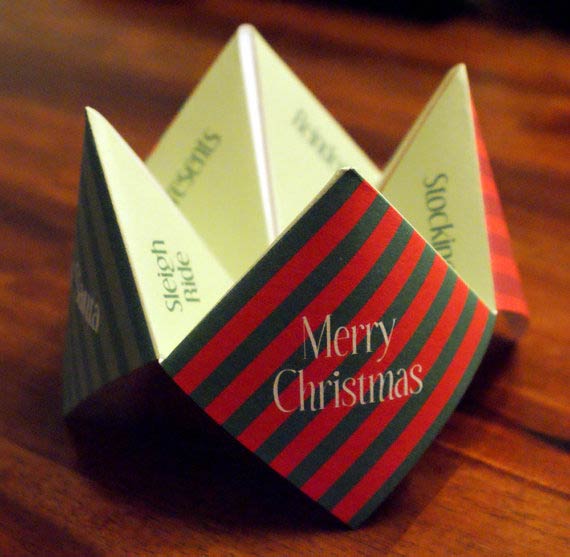
Unusual Christmas cards h/t DesignByTenisha (via Jayce-O-Yesta)
  • Early cards were expensive: Early Christmas cards were not accessible to everyone. They were often handmade or hand-colored and were considered a luxury item affordable only by the affluent.
  • Influence of Queen Victoria: Queen Victoria and Prince Albert played a significant role in popularizing the Christmas card tradition. They exchanged Christmas cards with their family and friends, and this royal endorsement further popularized the practice.
  • Louis Prang, the “Father of the American Christmas card”: Louis Prang, a German immigrant to the United States, is often credited with popularizing the Christmas card tradition in America in the late 19th century. He is known as the “Father of the American Christmas card.”
  • Record for the most Christmas cards sent: The record for sending the most Christmas cards in a single year is held by Robin Smith from the United Kingdom. In 1990, he sent 205,000 Christmas cards, earning him a place in the Guinness World Records.
  • Charitable Christmas cards: Many organisations produce Christmas cards with the proceeds going to charity. Purchasing and sending these cards is a way for people to support various causes during the holiday season.
  • Digital Christmas cards: In the digital age, e-cards and digital Christmas greetings have become increasingly popular. People send electronic cards via email or social media to connect with loved ones, especially if they are far away.
  • Worldwide variations: While Christmas cards are a well-known tradition in many countries, each culture may have its unique customs and designs. For example, Japanese New Year’s cards (nengajo) are similar to Christmas cards but are sent for the New Year holiday.
  • The Christmas Card Act: In the United Kingdom, the Postal Services Act 2000 legally required Royal Mail to deliver all Christmas cards for the price of a standard stamp. This ensures that cards are accessible to all.
  • Personalised cards: Many people now personalise their Christmas cards with family photos and custom messages, making each card unique and special.

In a nutshell

Christmas e-cards h/t eCO2

Christmas cards have become an integral part of the holiday season, allowing people to connect with friends and family near and far, exchange warm wishes, and spread joy and goodwill during this festive time of year. The tradition has evolved and adapted with technology, but the sentiment of sharing holiday greetings remains at its core.

Coda

Here is DALL-E 3’s take on the Yule Lads receiving and opening Christmas cards sent to them in the post to their home in Iceland.
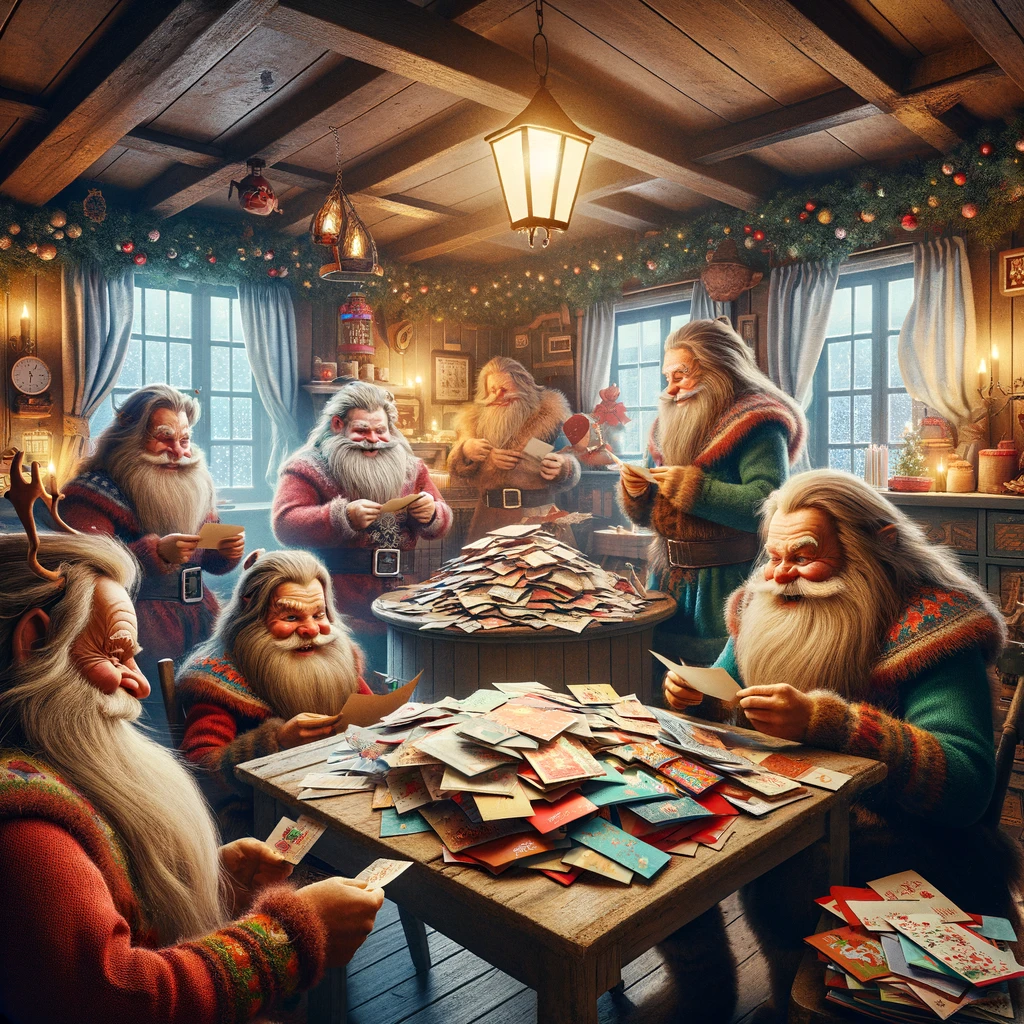
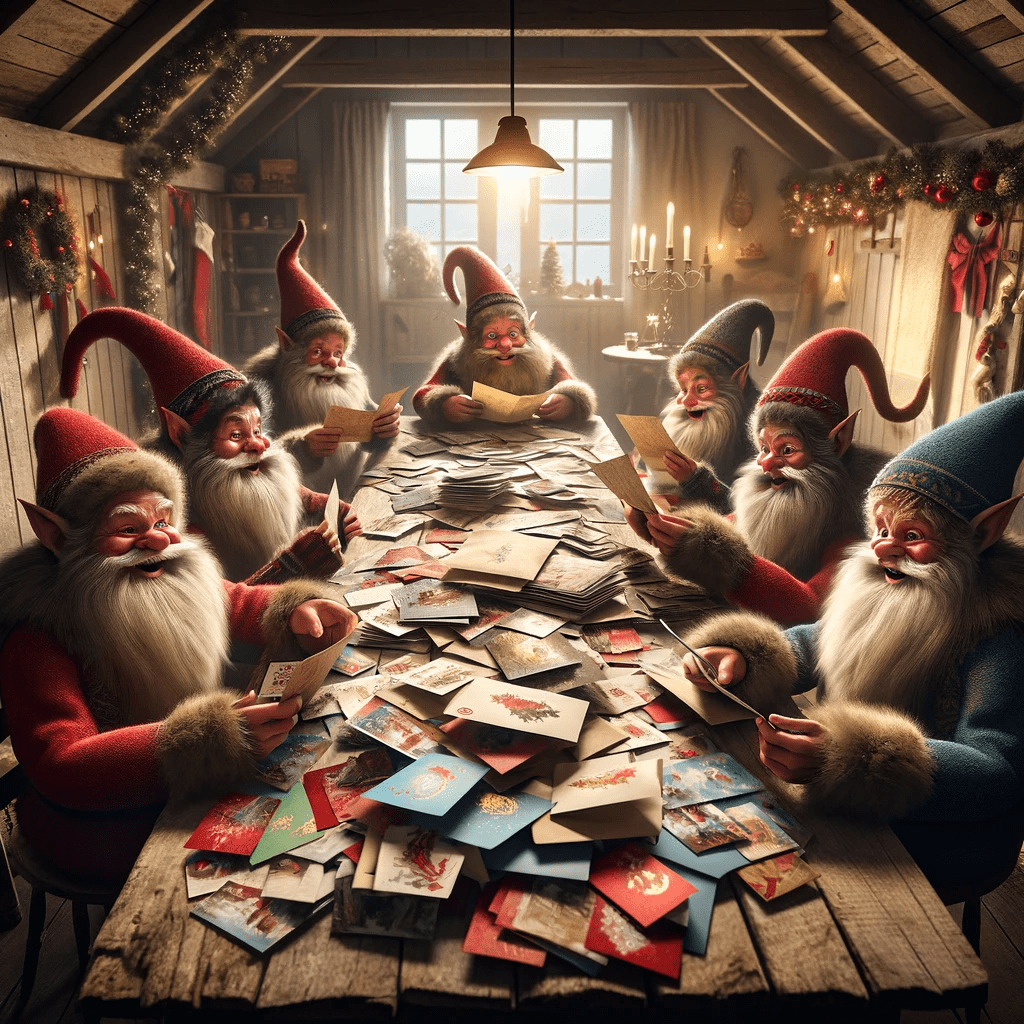
Leave a comment

Christmas traditions (Advent calendar, Day 4)

What is the origin story of Christmas stockings?

Christmas stockings h/t Fruugo

The tradition of hanging Christmas stockings by the fireplace for Santa Claus to fill with gifts on Christmas Eve has a charming origin story. Here’s how it is believed to have begun:

  • Saint Nicholas and the three sisters: The origins of the Christmas stocking tradition are often traced back to Saint Nicholas, the 4th-century Christian bishop known for his generosity. According to legend, Saint Nicholas heard about a poor man who couldn’t afford dowries for his three daughters, and he feared they would be forced into a life of destitution.
  • Saint Nicholas’ secret gift: Saint Nicholas wanted to help but didn’t want to draw attention to the family’s plight. So, he decided to secretly assist them. One night, he threw three bags of gold coins down the chimney of the family’s home. The bags landed in stockings hung by the fireplace to dry, providing the dowries needed for the daughters’ marriages.
  • Evolution of the tradition: Over time, the story of Saint Nicholas’s secret gift-giving evolved, and the practice of children hanging stockings by the fireplace in the hope of receiving gifts on Christmas Eve became widespread.

Interesting anecdotes about Christmas stockings

Christmas sacks h/t Mamas & Papas (via Marks & Spencer)
  • Different names for Santa: The figure who fills Christmas stockings goes by various names worldwide. In the United States and Canada, he is known as Santa Claus. In the United Kingdom and some other English-speaking countries, he is Father Christmas. In France, he is Père Noël, and in Italy, he is Babbo Natale.
  • Hung by the fireplace: The tradition of hanging stockings by the fireplace remains strong in many countries. The idea is that Santa Claus enters the house through the chimney and fills the stockings with gifts.
  • Stocking stuffers: Stockings are typically filled with small gifts and treats, such as candy, chocolates, small toys, and fruit. These are often referred to as “stocking stuffers”.
  • Personalised stockings: Many families have personalised stockings for each member of the household, often with names embroidered or written on them. These stockings are reused year after year.
  • Socks for stockings: In some countries, children use socks instead of stockings. These socks are often hung on a bedpost or other suitable location.
  • Santa sacks: In Australia, it’s common to use large, decorative sacks instead of stockings to hold Christmas gifts.
  • Norwegian tradition: In Norway, there is a charming tradition called “Julestrømpe” or “Christmas stocking.” It involves children secretly crafting a stocking for their parents and filling it with small gifts as a way to express love and appreciation.
  • Santa’s Naughty List: In some variations of the tradition, children who have misbehaved throughout the year may find a lump of coal in their stockings as a playful reminder to be better behaved.
  • International variations: While the Christmas stocking tradition is widely recognised, each country may have its unique customs related to stockings or similar traditions. For example, in some parts of Europe, children leave out shoes instead of stockings.
  • Christmas charity: Many charitable organisations and community groups collect stockings filled with gifts to distribute to those in need during the holiday season, embodying the spirit of giving and generosity.
Santa’s Naughty List h/t The Sun

In a nutshell

The tradition of hanging Christmas stockings is a heartwarming part of the holiday season, symbolizing the joy of receiving and giving to loved ones. It continues to be a beloved tradition in many cultures, with each family adding its personal touches and variations to make it special.

Coda

Here is DALL-E 3’s idea of the Yule Lads in the process of hanging up their own Christmas stockings from the mantlepiece of a fireplace inside an Icelandic house.