
Jolabokaflod

Christmas Book Flood • Reading for Pleasure


Leave a comment

Christmas traditions (Advent calendar, Day 5)

What is the origin story of Christmas cards?

First Christmas card h/t V&A

The tradition of sending Christmas cards dates back to the 19th century in England, with its roots firmly planted in the British Isles. Here’s how this beloved tradition began:

  • Early card sending: The concept of exchanging cards during the Christmas season existed for centuries before the first official Christmas card was created. People would send handwritten notes, letters, and small tokens of goodwill to friends and family during the holidays.
  • Sir Henry Cole and the first Christmas card: The credit for the first Christmas card goes to Sir Henry Cole, a British civil servant, and John Horsley, a well-known illustrator. In 1843, Cole found himself too busy to write individual Christmas greetings to friends and family. To save time, he commissioned Horsley to design a card that could be mass-produced.
  • The design: The resulting card featured a simple design with a central panel depicting a family enjoying Christmas festivities. The card’s greeting read, “A Merry Christmas and a Happy New Year to You.” It was printed in a small quantity and was initially met with mixed reactions due to the depiction of a child drinking wine.
  • Popularity and spread: Despite the initial controversy, Christmas cards gained popularity in Britain over the years. The introduction of the penny postage system in the 1840s made it more affordable to send mail, contributing to the growth of the tradition.

Interesting anecdotes about Christmas cards
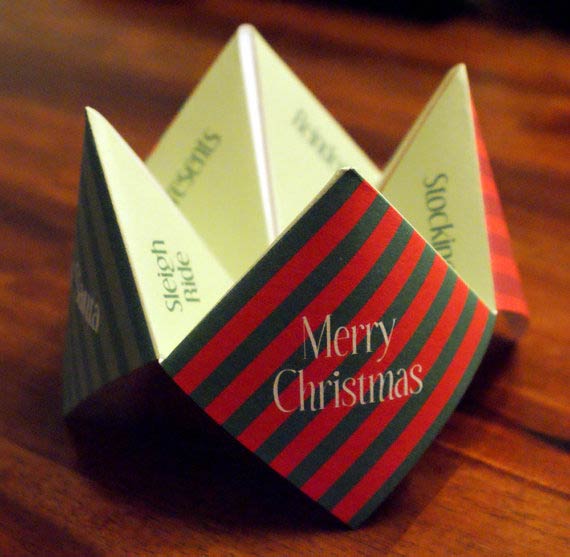
Unusual Christmas cards h/t DesignByTenisha (via Jayce-O-Yesta)
  • Early cards were expensive: Early Christmas cards were not accessible to everyone. They were often handmade or hand-colored and were considered a luxury item affordable only by the affluent.
  • Influence of Queen Victoria: Queen Victoria and Prince Albert played a significant role in popularizing the Christmas card tradition. They exchanged Christmas cards with their family and friends, and this royal endorsement further popularized the practice.
  • Louis Prang, the “Father of the American Christmas card”: Louis Prang, a German immigrant to the United States, is often credited with popularizing the Christmas card tradition in America in the late 19th century. He is known as the “Father of the American Christmas card.”
  • Record for the most Christmas cards sent: The record for sending the most Christmas cards in a single year is held by Robin Smith from the United Kingdom. In 1990, he sent 205,000 Christmas cards, earning him a place in the Guinness World Records.
  • Charitable Christmas cards: Many organisations produce Christmas cards with the proceeds going to charity. Purchasing and sending these cards is a way for people to support various causes during the holiday season.
  • Digital Christmas cards: In the digital age, e-cards and digital Christmas greetings have become increasingly popular. People send electronic cards via email or social media to connect with loved ones, especially if they are far away.
  • Worldwide variations: While Christmas cards are a well-known tradition in many countries, each culture may have its unique customs and designs. For example, Japanese New Year’s cards (nengajo) are similar to Christmas cards but are sent for the New Year holiday.
  • The Christmas Card Act: In the United Kingdom, the Postal Services Act 2000 legally required Royal Mail to deliver all Christmas cards for the price of a standard stamp. This ensures that cards are accessible to all.
  • Personalised cards: Many people now personalise their Christmas cards with family photos and custom messages, making each card unique and special.

In a nutshell

Christmas e-cards h/t eCO2

Christmas cards have become an integral part of the holiday season, allowing people to connect with friends and family near and far, exchange warm wishes, and spread joy and goodwill during this festive time of year. The tradition has evolved and adapted with technology, but the sentiment of sharing holiday greetings remains at its core.

Coda

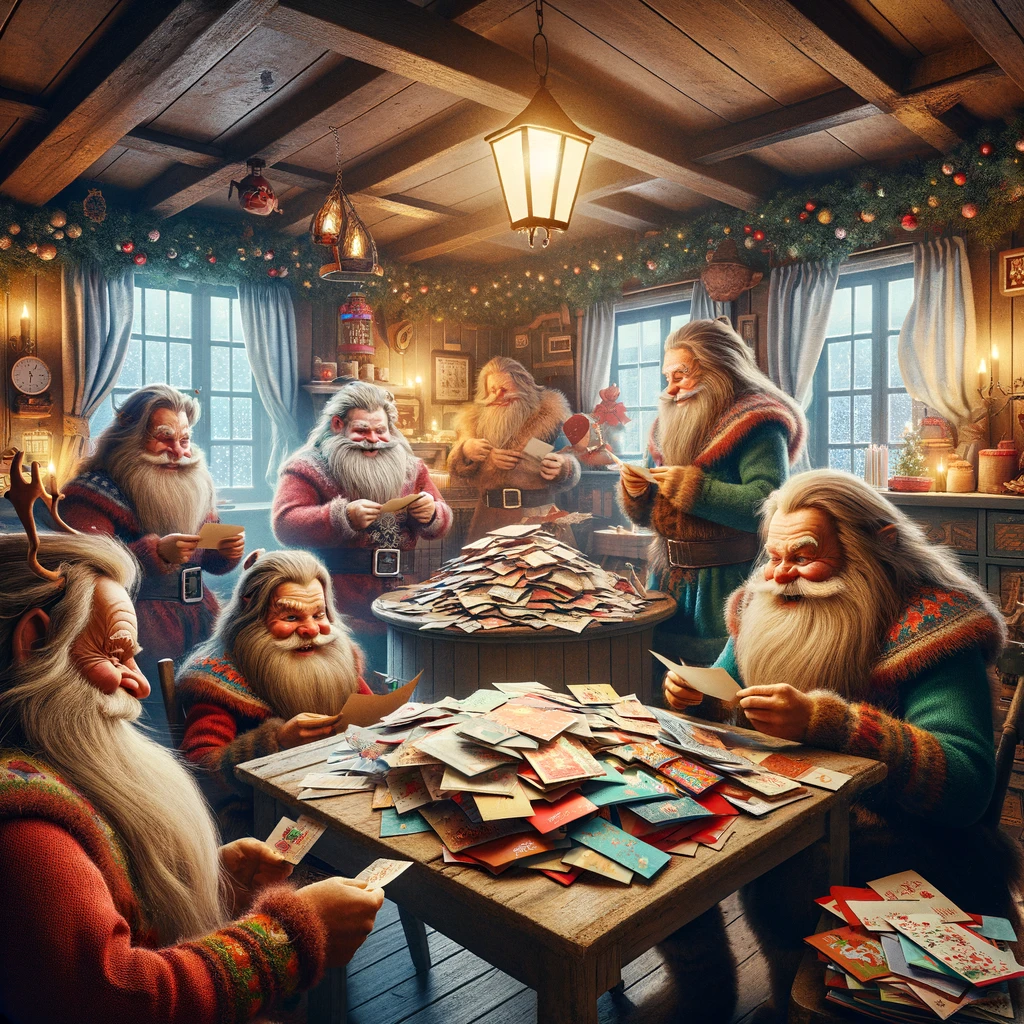
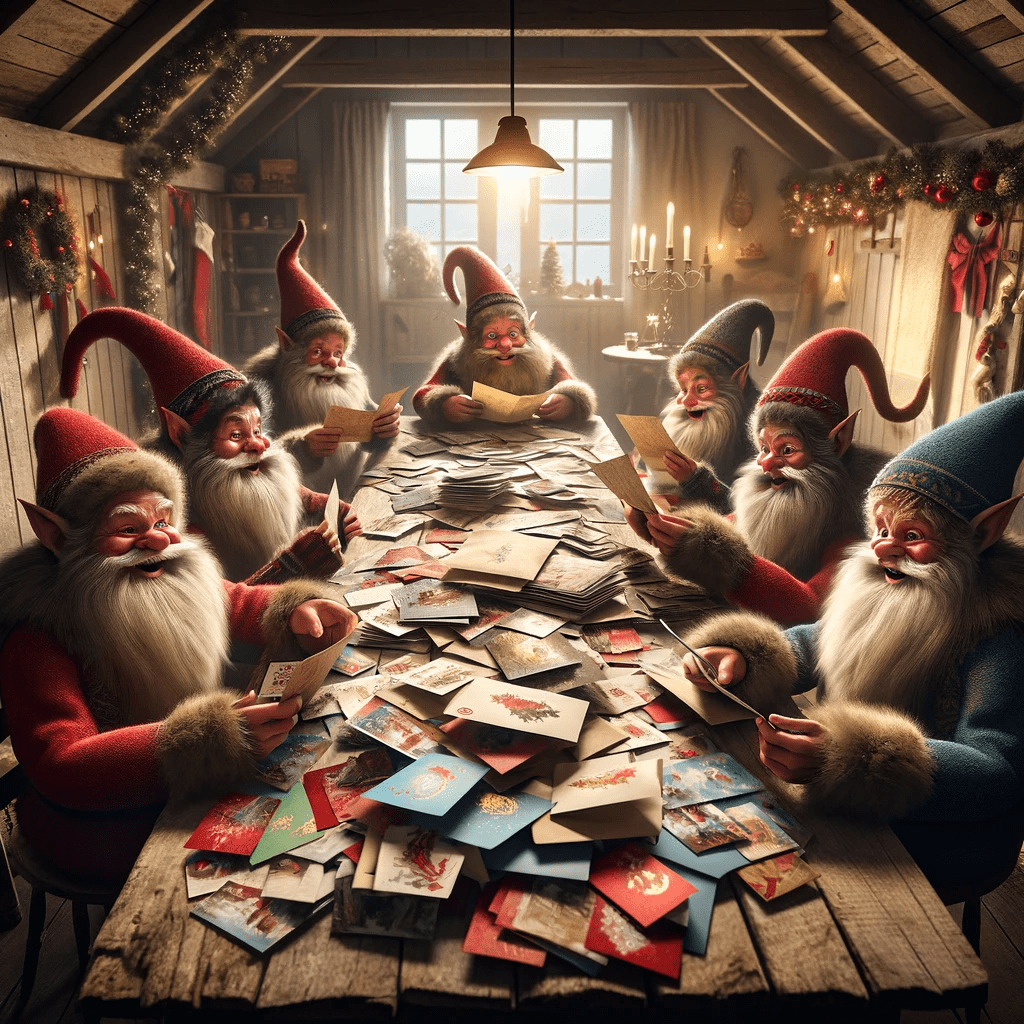
Here is DALL-E 3’s take on the Yule Lads receiving and opening Christmas cards sent to them in the post to their home in Iceland.
Leave a comment

Christmas traditions (Advent calendar, Day 4)

What is the origin story of Christmas stockings?

Christmas stockings h/t Fruugo

The tradition of hanging Christmas stockings by the fireplace for Santa Claus to fill with gifts on Christmas Eve has a charming origin story. Here’s how it is believed to have begun:

  • Saint Nicholas and the three sisters: The origins of the Christmas stocking tradition are often traced back to Saint Nicholas, the 4th-century Christian bishop known for his generosity. According to legend, Saint Nicholas heard about a poor man who couldn’t afford dowries for his three daughters, and he feared they would be forced into a life of destitution.
  • Saint Nicholas’ secret gift: Saint Nicholas wanted to help but didn’t want to draw attention to the family’s plight. So, he decided to secretly assist them. One night, he threw three bags of gold coins down the chimney of the family’s home. The bags landed in stockings hung by the fireplace to dry, providing the dowries needed for the daughters’ marriages.
  • Evolution of the tradition: Over time, the story of Saint Nicholas’s secret gift-giving evolved, and the practice of children hanging stockings by the fireplace in the hope of receiving gifts on Christmas Eve became widespread.

Interesting anecdotes about Christmas stockings

Christmas sacks h/t Mamas & Papas (via Marks & Spencer)
  • Different names for Santa: The figure who fills Christmas stockings goes by various names worldwide. In the United States and Canada, he is known as Santa Claus. In the United Kingdom and some other English-speaking countries, he is Father Christmas. In France, he is Père Noël, and in Italy, he is Babbo Natale.
  • Hung by the fireplace: The tradition of hanging stockings by the fireplace remains strong in many countries. The idea is that Santa Claus enters the house through the chimney and fills the stockings with gifts.
  • Stocking stuffers: Stockings are typically filled with small gifts and treats, such as candy, chocolates, small toys, and fruit. These are often referred to as “stocking stuffers”.
  • Personalised stockings: Many families have personalised stockings for each member of the household, often with names embroidered or written on them. These stockings are reused year after year.
  • Socks for stockings: In some countries, children use socks instead of stockings. These socks are often hung on a bedpost or other suitable location.
  • Santa sacks: In Australia, it’s common to use large, decorative sacks instead of stockings to hold Christmas gifts.
  • Norwegian tradition: In Norway, there is a charming tradition called “Julestrømpe” or “Christmas stocking.” It involves children secretly crafting a stocking for their parents and filling it with small gifts as a way to express love and appreciation.
  • Santa’s Naughty List: In some variations of the tradition, children who have misbehaved throughout the year may find a lump of coal in their stockings as a playful reminder to be better behaved.
  • International variations: While the Christmas stocking tradition is widely recognised, each country may have its unique customs related to stockings or similar traditions. For example, in some parts of Europe, children leave out shoes instead of stockings.
  • Christmas charity: Many charitable organisations and community groups collect stockings filled with gifts to distribute to those in need during the holiday season, embodying the spirit of giving and generosity.
Santa’s Naughty List h/t The Sun

In a nutshell

The tradition of hanging Christmas stockings is a heartwarming part of the holiday season, symbolizing the joy of receiving and giving to loved ones. It continues to be a beloved tradition in many cultures, with each family adding its personal touches and variations to make it special.

Coda

Here is DALL-E 3’s idea of the Yule Lads in the process of hanging up their own Christmas stockings from the mantlepiece of a fireplace inside an Icelandic house.


Leave a comment

Christmas traditions (Advent calendar, Day 3)

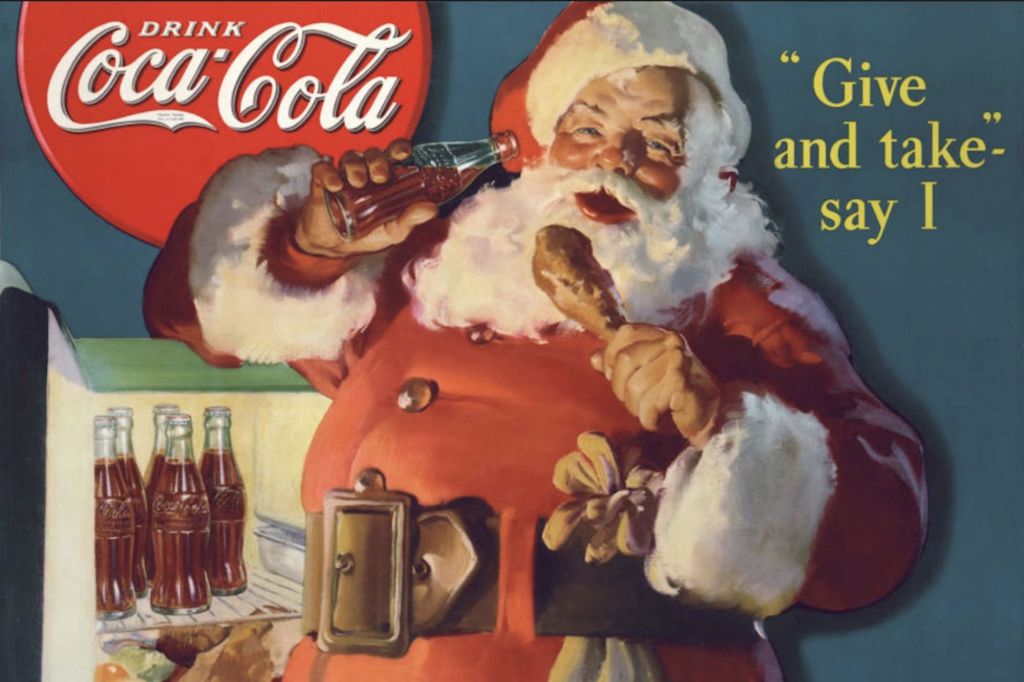
Coca-Cola ad from the 1930s

What is the origin story of Santa Claus?

The figure of Santa Claus – known by various names including Father Christmas, Kris Kringle and Saint Nicholas – has evolved over centuries and has been shaped by a combination of Christian traditions, folklore and historical figures. Here’s a brief overview of the origin story of Santa Claus:

  • Saint Nicholas: The origin of Santa Claus can be traced back to Saint Nicholas, a 4th-century Christian bishop who lived in what is now modern-day Turkey. Saint Nicholas was known for his acts of kindness and generosity, especially toward children and those in need.
  • Evolution of the legend: Over time, stories and legends about Saint Nicholas’s generosity spread across Europe. He became the patron saint of children and sailors. In many countries, Saint Nicholas Day is celebrated on 6th December, and children receive gifts in his honour.
  • Dutch influence: Dutch immigrants to the United States brought with them the tradition of celebrating Sinterklaas (Saint Nicholas) on 5th December, a custom that eventually merged with the Christmas holiday in America. Sinterklaas evolved into “Santa Claus”.
  • Coca-Cola’s Influence: In the 1930s, Coca-Cola played a significant role in shaping the modern image of Santa Claus. They commissioned artist Haddon Sundblom to create a series of images featuring a plump, jolly Santa Claus enjoying Coca-Cola. This popularised the image of Santa as we know him today, with a red suit and white beard.
NORAD SantaTracker

Interesting anecdotes about Santa Claus

  • International names and variations: Santa Claus goes by different names and variations in various countries. For example, in France, he is Père Noël; in Italy, he is Babbo Natale; in Russia, he is Ded Moroz; and in the Netherlands, he is Sinterklaas, who has a helper named Zwarte Piet.
  • Santa’s mail: Many countries have dedicated addresses where children can send letters to Santa Claus. These letters often receive responses from volunteers or postal workers.
  • NORAD Santa Tracker: Since 1955, the North American Aerospace Defense Command (NORAD) has been tracking Santa Claus’s journey around the world on Christmas Eve. It began as a result of a misprinted phone number in a newspaper ad, and it has become a popular tradition.
  • SantaCon: In cities around the world, SantaCon is an annual event where people dress up as Santa Claus and participate in a pub crawl or other festive activities.
  • Santa’s transportation: In many cultures, Santa Claus is believed to travel in various ways. In the United States, he’s said to use a sleigh pulled by reindeer, while in some European countries, he arrives on a horse or even by boat.
  • Leaving out treats: In the United States and other countries, it’s a tradition for children to leave out milk and cookies for Santa Claus as a token of appreciation for his gift-giving.
  • Santa parades: Santa Claus often appears in parades leading up to Christmas, including the Macy’s Thanksgiving Day Parade in New York City.
  • The Santa Claus Oath: There is an official Santa Claus Oath that many individuals who portray Santa Claus in public take, pledging to uphold the values and spirit of Santa.
  • Santa’s workshop: The North Pole is commonly depicted as the location of Santa’s workshop, where he and his elves make toys for children. This imagery has become deeply ingrained in the Santa Claus legend.
  • Acts of kindness: Many people embrace the spirit of Santa Claus by engaging in acts of kindness and charity during the holiday season, helping those in need and spreading joy.
SantaCon, New York City

In a nutshell

The story of Santa Claus is a heartwarming tale that has transcended borders and cultures, bringing joy and goodwill to people around the world during the Christmas season. Santa represents the spirit of giving, generosity, and the magic of the holidays.

Coda

Putting DALL-E 3’s imagination to work, here are a couple of images showing the Yule Lads greeting Santa Claus, as his reindeer pull a flying sled across the sky, all in an Icelandic landscape.


Leave a comment

Christmas traditions (Advent calendar, Day 2)

Iceland

What is the origin story of the Christmas tree?

The tradition of decorating and displaying Christmas trees during the holiday season has roots in various cultures and time periods, but it became widely popular in its current form in 19th-century Europe.

Today, this practice is common across the world over the festive period. This post includes images from four different countries. How many pictures of Christmas trees in other countries can you find?

Here’s a brief overview of the origin story:

Gubbio, Italy
  • Ancient origins: The idea of bringing evergreen plants indoors during the winter months has ancient roots. In pagan traditions, evergreen trees and branches were seen as symbols of life and hope during the dark, cold winter. People would decorate them with items like candles, fruit, and nuts.
  • Christian adoption: In medieval Europe, the early Christian Church adopted some of these pagan customs and incorporated them into their Christmas celebrations. The evergreen tree came to symbolize the Tree of Life and was used to represent the promise of eternal life through Jesus Christ.
  • Germany in the 16th century: The tradition of the Christmas tree, as we know it today, is often attributed to 16th-century Germany. Some historical accounts suggest that Martin Luther, the Protestant Reformer, was the first to decorate a Christmas tree with candles. He was said to be inspired by the beauty of the stars shining through evergreen trees while walking in the forest.
  • Royal influence: The Christmas tree tradition became more widespread in Germany and other European countries during the 18th and 19th centuries. It gained royal approval when Queen Victoria and Prince Albert, who was of German descent, were depicted with a decorated Christmas tree in a popular illustration in 1848. This image helped popularize the tradition in England and beyond.
  • Arrival in the United States: The tradition of the Christmas tree was introduced to the United States by German immigrants in the 19th century. It gained broader popularity in the USA following the publication of a picture of Queen Victoria and Prince Albert’s Christmas tree in a popular magazine.

Interesting anecdotes about Christmas trees

Rockefeller Center, NYC
  • Rockefeller Center Christmas tree: The lighting of the Rockefeller Center Christmas tree in New York City has become a highly anticipated annual event. The first tree was erected in 1931 during the Great Depression, and it has since become an iconic symbol of the holiday season in the United States.
  • Tallest Christmas tree: In 2020, a Christmas tree from the state of New York made headlines as the tallest Christmas tree ever displayed at Rockefeller Center, measuring over 100 feet tall.
  • Edible Christmas trees: In some cultures, especially in Scandinavia, it is traditional to make edible Christmas trees using bread, gingerbread cookies, or other treats. These trees are often decorated with candies and fruits.
  • Environmental concerns: In recent years, there has been a growing awareness of the environmental impact of cut Christmas trees. Many people now opt for artificial trees or participate in tree recycling programs to reduce waste.
  • Specialised tree decorations: Some Christmas trees are adorned with unique and specialized decorations. For example, in Japan, it’s common to decorate trees with paper cranes, and in Mexico, they may hang colorful piñatas.
  • National Christmas trees: Many countries have their own national Christmas trees. For example, the National Christmas Tree in Washington, DC, has been a tradition since 1923 when President Calvin Coolidge lit the first tree.
  • World’s most expensive Christmas tree: In 2019, a Christmas tree in Marbella, Spain, was valued at over $15 million. It was adorned with diamonds, sapphires, and other precious gems.
Rio de Janeiro, Brazil

In a nutshell

The Christmas tree has evolved from a symbol of hope and faith to a widely recognized and cherished part of the holiday season around the world. It continues to be a central element of Christmas celebrations in many cultures, with each region adding its unique customs and decorations to this beloved tradition.

Coda

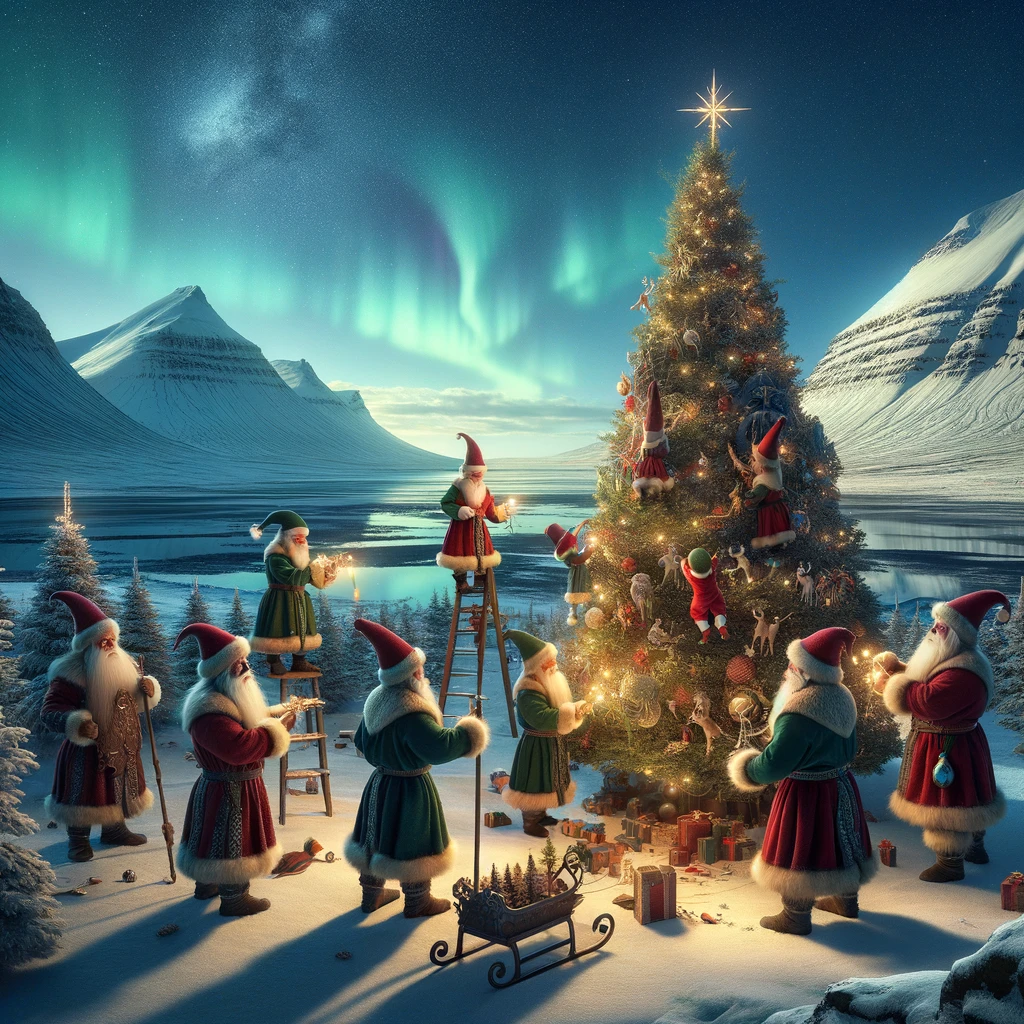
As a flight of fancy, here are a couple of DALL-E 3 images showing the Yule Lads putting decorations on a Christmas tree in an Icelandic landscape.


Leave a comment

Christmas book flood 2023

The tidal wave is coming

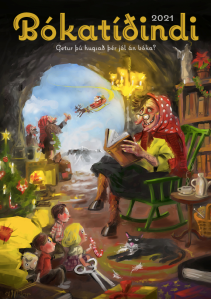
Every year in Iceland a new tidal wave of books crashes onto the nation’s beaches for citizens to become aware of via the Bókati∂indi (Book Bulletin) printed catalogue, a copy of which is sent in the post to every home address in the country.

The catalogue always features around 800 newly published book titles across a full range of different categories and genres for fiction, non-fiction and children’s books.

You can download your copy by clicking the Download button on the PDF link above.

Here is the full-length A4-size front cover for this year’s Bókati∂indi catalogue…

The English translation for the Icelandic phrase “Getur þú hu qui∂ þór jól ∂u bóka?” – displayed on the cover on the roof under where Santa and his singular reindeer is parked – equates to “Can you book a book for Christmas?” or, more eloquently, “Can you procure a book for Christmas?”

By way of a little AI image generator fun, here are a couple of dream-like compositions DALL-E 3 wrangled with the prompt for the Yule Lads to be reading books washed up on an Icelandic beach as a result of the annual book flood tidal wave.

Is there a real beach in Iceland with these rock formations or are the landscapes in these images a figment of DALL-E 3’s febrile imagination?


Leave a comment

Christmas traditions (Advent calendar, Day 1)

What is the origin story of the Advent calendar?

The tradition of advent calendars can be traced back to Germany in the 19th century. The word “Advent” comes from the Latin word “adventus,” which means “coming” or “arrival.” Advent calendars were created as a way for Christians to mark the 24 days leading up to Christmas, which is the celebration of the birth of Jesus Christ. It served as a way to build anticipation and prepare spiritually for the Christmas season.

The earliest advent calendars were simple chalk lines drawn on doors or walls, with a chalk mark made each day to count down to Christmas. Eventually, this practice evolved into the use of candles, where a new candle would be lit each day. The modern advent calendar, as we know it today, with small doors or compartments containing hidden treats or pictures, emerged in the early 20th century.

Interesting anecdotes about Advent calendars

  • Invention of the first printed Advent calendar: In the early 20th century, a German named Gerhard Lang is often credited with producing the first printed advent calendar. He was inspired by a childhood memory of a calendar his mother made for him with 24 small candies attached to a piece of cardboard.
  • Religious and secular Advent calendars: While advent calendars have their origins in the Christian tradition of counting down to Christmas, many modern advent calendars are secular and may contain chocolates, toys, or other small gifts. Some advent calendars even feature popular non-religious symbols like Santa Claus.
  • Variety of designs: Advent calendars come in a wide variety of designs and themes. Some are traditional, featuring nativity scenes and religious imagery. Others may showcase winter scenes, Santa Claus, or beloved characters from books and movies. There are even DIY advent calendars that people create with personalized themes.
  • International appeal: The use of advent calendars has spread beyond Germany and is now popular in many countries around the world. Each culture may have its unique take on the tradition. For example, in Sweden, it’s common to have an advent candle, and in Iceland, there’s a tradition of giving books on Christmas Eve, which aligns with the advent season.
  • Advent calendar records: In 2007, a Guinness World Record was set for the largest advent calendar. It was created in the UK and measured over 71 meters in length, with each day’s door measuring about 3.5 meters high.
  • Advent calendars in pop culture: Advent calendars have made their way into pop culture, with many companies producing special advent calendars featuring products like makeup, skincare, and gourmet foods. These calendars have become highly sought-after collector’s items.
  • Charity Advent calendars: Some advent calendars are designed to promote charitable giving. Instead of receiving gifts or chocolates, each day may reveal a charitable act or donation to be made, encouraging kindness and generosity during the holiday season.

In a nutshell

Advent calendars have evolved over the years from simple chalk marks to complex and creative designs. They continue to be a beloved tradition that brings joy and anticipation to the Christmas season for people of all ages, both for religious and secular celebrations.


Leave a comment

The Christmas Cat

Christmas is not only a time in Iceland to celebrate the nation’s love of books; it’s also a time to get serious about wrapping up warm. If Icelandic children don’t get new clothes for Christmas, legend has it that a monstrous black Yule Cat will pounce and eat them up. It makes sense for parents to clothe their children well to keep them well-protected against inclement weather.

Although the origins of the myth are hazy, the cat is related to the story of the ogress Grýla and her thirteen Yule Lad offspring. The feline menace was popularised in a famous poem by Jóhannes úr Kötlum (1899–1972) – ‘Jólakötturinn‘ (‘The Christmas Cat‘) – that was in turn put to music by pop icon, Björk.

All the more reason to snuggle up in comfort reading next to a roaring fire, drink in hand, reading a new book gifted for Christmas, while the wind, rain and snow rage outside.

Happy Jolabokaflod. This Christmas, may you give the books you cherish, receive the books you desire, and read the books you love.


2 Comments

Secret Santa 2022

From Thanksgiving to Christmas, Jolabokaflod CIC is hosting a worldwide party to celebrate the joy of reading. This year we are celebrating Jólabókaflóðið (The Christmas book flood) by sharing with you the chance to gift and receive books from reader friends around the world you have yet to meet.

All you have to do to take part in this Secret Santa book gifting campaign is to send us your first name and best email address via this landing page website: Secret Santa Book Gift. In return, we shall send you full details about how the process works, beyond the basic information on the landing page.

What are you waiting for? Santas of the world, unite! Let’s have some fun.


Leave a comment

Our Book Bulletin for 2021

Iceland’s ‘Book Bulletin’ for Jolabokaflod at Christmas 2021

Merry Christmas, everyone – and happy Jolabokaflod for 24 December. We hope you received the books you wanted and are already deep in concentration, reading – lost in the worlds created by the writing on the page.

On the surface 2021 has been a second fallow year for Jolabokaflod CIC, due to lockdown caused by the coronavirus pandemic. You will be glad to learn, however, that we have been hard at work at a deeper level out of the necessity to pivot. Here are some of the activities we initiated during the year.

Refuge in Literacy UK

In February 2021, our Founder (Christopher Norris) began to mentor children’s author Anne Stairmand about setting up a social enterprise to build on a generous gift she donated at Christmas 2020 when she gave 50 signed copies of her books to a local refuge centre. The strength of the positive reaction she received inspired her to make this connection more permanent.

We guided Anne on her journey to create a not-for-profit company called Refuge in Literacy UK with two meta goals:

  • Ensuring children in refuge own copies of books signed by their authors
  • Teaching parents how to support their children’s learning how to read successfully

Refuge in Literacy UK soft-launched in November 2021 with an in-person conference-style event to bring the CIC’s stakeholders together for the first time and to share the vision for the future.

At Christmas 2021, the company has a board of 10 people and is working to send more signed books to refuges, with around 30 authors in the scheme already. It is also creating reading prompts that will help parents read the books with their children.

Christopher has agreed to become a non-executive director of Refuge in Literacy UK in the New Year, advising on strategy and fundraising at the company’s biannual board meetings. The social enterprise is set to grow rapidly in 2022.

Theme of the month at Founders and Mentors

In October 2021 we were delighted to publish a month of themed content in The Creative Collective community at Founders and Mentors, the free-to-access platform that supports pre-launch founders, inventors and creatives with free mentoring to launch startups, inventions and creative projects more successfully. This content comprised information, polls, questions and a ‘call to action’ for member s to consider making Jolabokaflod part of the way they celebrate the festive season, whether or not they celebrate Christmas.

The Wisdom of Coffee

The month of promotion was backed up by the Wisdom of Coffee network, both at its eponymous Founders and Mentors community (The Wisdom of Coffee) and at its Meetup group (The Wisdom of Coffee), remaining members to get involved with the Jolabokaflod tradition.

Secret Santa with a twist

We ran a pilot scheme at Founders and Mentors to run a ‘Secret Santa’-style promotion with a Jolabokaflod flavour: Secret Jólasveinn

We invited members of the Founders and Mentors global network to participate in a scheme to buy and send a book of their choice to the person they selected at random ‘out of the Santa hat’. Seven members participated in the pilot.

Although this was a small group of people in the inaugural event, everyone enjoyed the activity as a way of engaging with each other and the wider Founders and Mentors community.

We shall scale up the Secret Jólasveinn project for Christmas 2022, so that everyone who wants to take part can do so, wherever they are in the world.

What’s next?

The Omicron variant of Covid-19 is surging as we post this update. The future is unclear from this vantage point as to when everyone will be able to resume their lives unaffected by protocols imposed as a result of the coronavirus pandemic. There are a few things, however, that we can predict with some degree of certainty:

  • The end of the pandemic is not currently in sight, especially if vaccines and other treatments are not shared globally by countries with the resources to do so
  • Life will be different for all of us once the pandemic is in the rear-view mirror
  • Our collective tastes and preferences may change in the light of our experience of living through a pandemic.

With so much unknown about the future, Jolabokaflod CIC will continue to stay agile in how we promote the ‘Christmas book flood’ tradition around the world. We have plenty of ideas in the pipeline, which we shall reveal and promote at the appropriate time – and as the pandemic allows.

Enough from us – now enjoy the rest of the festive season and go bury your head in a book.

Jolabokaflod CIC


2 Comments

Jolabokaflod for the ages

In 75 years of celebrating Jólabókaflóðið in Iceland, never has there been a greater need for ‘The Christmas Book Flood’ than this holiday season in 2020. As the pandemic lingers throughout the world, reading for pleasure gives all of us (Icelanders included) the opportunity to escape our social isolation, whether or not we are in lockdown where we are living.

This evening, people in Iceland have celebrated their main Christmas meal, perhaps drinking Jólabland (a traditional mix of brown ale and fizzy orangeade), exchanging presents – with books a highlight, chosen from this year’s Bókatíðindi catalogue of new titles – and snuggling down to read their new gifts over the holidays as the perfect way of leaving the stresses of life behind for a while.

Here at Jolabokaflod CIC, 2020 has been a year of preparation for the future. We had to pivot from our plans for the year when the first lockdown in the UK took hold in March. While we have not promoted Jólabókaflóðið visibly in 2020, this year of fallow times has given us the chance to prepare for a coming period of activity for everyone to see once the forthcoming vaccination program allows. We have not been idle behind the scenes.

So, let’s life a glass of Jólabland to celebrating Christmas this year in the best way we can and raise a toast for the promise of the New Year. We are exciting about starting to share our plans for 2021 very soon.